
The Australian High Commission is pleased to support the premiere screening of the digitally restored Tukana-Husat I Asua (1982). The film was shown at Paradise Cinemas on 4 November and was a simultaneous screening with the film screening at the National Film and Sound Archive of Australia (NFSA)’s Arc Cinema in Canberra.
Tukana has been digitally restored by the National Film and Sound Archive of Australia in partnership with Spectrum Films and gifted to Papua New Guinea’s National Film Institute to commemorate 50 years of Papua New Guinea’s Independence. The restoration builds on a four-year co-design project with the Institute, assisting them to better preserve and access their films, with funding from the Australian Government’s International Cultural Diplomacy and Arts Fund.
This initiative is a demonstration of Papua New Guinean and Australian cultural sector collaboration. The screening event was supported through the Australian High Commission’s Yumi Stap Wantaim campaign that celebrates 50 years of Papua New Guinea’s independence and the deep and enduring ties between our two countries.
Minister for Police and Acting Minister for ICT, Hon. Peter Tsiamalili Jr. said “it doesn't matter how old you get, this movie [Tukana] pulls family together and still, the anchor of the story still resonates today. I'm proud that I'm able to come here and see what's been done with the collaboration between Australia and PNG, particularly in the film industry, and that this will continue to inspire the new industry in our country, and 50 years is a time for us to really elevate and excel in this industry.”
NFI’s Film Archivist Zoe Baru said “the collaboration with the NFSA provided the practical support to enable the NFI to preserve and digitise our films, the collection is now accessible to us and we look forward to sharing with the PNG public for generations to come.”
Deputy CEO of the National Film and Sound Archive of Australia, Jacqui Uhlmann said “as we did the work, we started to understand just how important the film was and with the 50th anniversary of independence coming up we thought there is no better birthday present than a properly restored version of that film. We did it through our NFSA Restores program. That's where we do quite extensive technical restoration of a film which includes a digital clean-up, a rework of the audio and work on the colour.”
Meagan Loader, the NFSA’s Chief Curator said “working with the NFI on this co-designed project has established protocols and pathways that will protect the PNG national audiovisual collection.”
ENDS
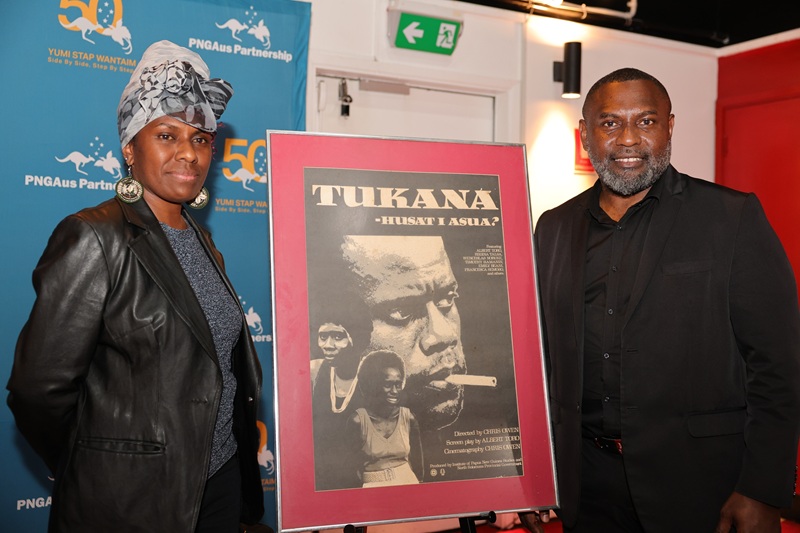
Filmmaker and daughter of the late Albert Toro, Ms Michelle Baru Toro with Minister for Police and Acting Minister for Information and Communication Technology, Hon Peter Tsiamalili Jr.
.
Media notes:
Background
As part of this project other significant documentaries digitised and preserved include Rabaul: The Past Remains (Richard Tucker, 1968); Axes and Aré: Stone Tools of the Duna (J Peter White, 1973); Ileksen: Politics for Papua New Guinea (Gary Kildea, 1977); Sepik River (1977); and Gogodala: A Cultural Revival? (Chris Owen, 1983).
The NFSA has designed, built and transported a Remote Onsite Digital Access (RODA) system so the NFI can access and share its newly digitised films from its headquarters in Goroka. The NFSA has also provided training and resources to staff at the NFI relating to audiovisual conservation, preservation, digitisation, archiving and digital access, with a commitment to creating professional skills expansion and continued opportunities.
About the National Film and Sound Archive of Australia
The National Film and Sound Archive of Australia is the national audiovisual cultural institution.
Photos attached and available at this link.
For further information, including access to related materials, please contact the Australian High Commission media team: +675 7090 0100